
Aspects of Form in Generative Music
Karlheinz Essl interviewed by Christophe RobertZoom Conference (29 June 2026)
Christophe Robert is a researcher specializing in generative music. He is the author of several articles and is currently a doctoral student at the University of Nice Côte d'Azur (France), where he is studying formal strategies in real-time generative music. He is the founder and editor of the Musicalgo website.
Which of your “autonomous” works (installations or pieces that can function without a live performance) would you say are the most complex in terms of their macro-form? Why?
I think it's Lexikon-Sonate (1992 ff). In terms of form, this is the most complex piece. Of course, the question is what we consider “form” to be. There are many different concepts of form, and my own understanding is certainly related to the concept of form in 20^(th)-century classical and avant-garde music. To me, form is the development of musical ideas over time, with those ideas undergoing many different transformations. We can see this in the works of the Second Viennese School, especially those of Anton Webern and Alban Berg, with the latter being called "the master of transitions" by Theodor W. Adorno.
Form is not just a framework for musical content. This is a rather banal concept of form that many people still have in mind. Instead, form is an organically developing system that is almost biological in nature. In this system, musical material is developed, varied and transformed. As it unfolds over time, it creates what we recognise as form. To me, form does not mean that everything flows continuously and always moves forward. It also involves revisiting ideas or materials that have already been used and placing them in a new context. This creates different relationships between musical ideas. This is my conception of form!
In Lexikon-Sonate, there is the idea of constantly combining three different types of musical models. Take a look the main user interface:

User interface of Lexikon-Sonate 3.2
Clickable map: Clicking on one of the boxes (such as 'Esprit')
will provide you with more information about this structure
and play a sound example (MIDI).
On the left, you have the different types of structure generators. Each module is a dedicated Max patch, and they all share more or less the same internal structure. Their combination is determined by a hidden conductor, which chooses which structure generators are active. Whenever I press the + key, or key one, the conductor makes a selection and starts one of these structure generators.
Each generator is assigned a particular ratio between active and passive sections, that is, between phrases filled with music and the rests between them. A setting of "three" means long musical phrases with short pauses between them, whereas "one" means very short musical phrases with longer pauses. By arranging them in this way, you determine which structure generator occupies the foreground, the middle ground, or the background. In the foreground, the generator is mostly active; in the background, it is mostly inactive.
And the idea is that you create these combinations. If I start now and trigger the first randomly selected structure generator, it will occupy this position and keep playing until I press the key again. Then a new generator will be selected, and the first one will move into this position. In other words, the foreground becomes the middle ground.
"Foreground" and "middle ground" refer to the probability of playing versus not playing. This is a concept that was developed by Stockhausen. He spoke about "Aktionsdauern" and "Pausendauern", the durations of action and of pauses. In other words, an active musical section has a certain duration, and the pauses between those sections also have a certain duration.
In Lexikon-Sonate, if you play a single generator module, it creates a phrase of a certain length, depending on a weight factor. Because you always have three modules playing simultaneously when you use the conductor to make the selections, there are always three processes running at the same time. However, whenever a new structure is selected, the previous combination changes: two of the modules remain, while one is replaced.
This means that the musical form, or the development of the music, does not change abruptly from one state to another. Instead, it always retains two structural models while introducing a new one. At the same time, the relationships between the structural models are continually changing. When you select the “auto” mode, the transition from one module to another happens automatically. So the conductor is, so to speak, conducted by another instance that determines when the next cue is given.
And how does this module “decide” when a change can occur?
There is a cue generator. When I switch it on, it generates cues at intervals ranging from four to twenty-four seconds in length, according to a logarithmic scale. So, it has a logarithmic function ranging from four to twenty-four seconds, which is divided into twelve different intervals. It then randomly selects one of these intervals.
You can see it's started now that I've switched it on. After ten seconds, the next cue will come after seventeen seconds. It has now selected an element called 'Generalpause', which clears everything. It creates a long pause.
The piece is very old. It's about thirty-five years old…
But it's still working. It's very rare for a generative work to have such longevity…
It's a major challenge to keep it running. Due to the many changes in computer architectures and operating systems over the years, I constantly have to perform these tedious updates just to keep it working.
And would you say that, in the process of keeping the program working, there have been slight modifications to the way the modules operate?
Not at all. The last major change I made was introducing the new Zheng model about ten years ago. It's based on the Chinese instrument of the same name because I was writing a piece for that instrument, which uses a particular type of pentatonic scale. I integrated this harmonic system into a new structure generator and haven't made any further additions since then. Since then, there has been no need to extend the system. The goal has simply been to maintain it.
With the next macOS update, Rosetta will no longer be available. Rosetta enables software designed for Intel processors to run on Apple Silicon. Essentially, it's a translation layer that converts Intel code so that it can still be executed.
Currently, for instance, I'm using a specific VST plug-in that was developed for Intel processors. It wasn't developed by me, but by MDA, an independent company. They created a piano simulation that sounds very good. The problem is that it won't run after the next operating system update.
Therefore, when I perform or demonstrate the piece now, I use Pianoteq instead. It's a physically modelled piano that sounds really good. The only issue is that it has to be purchased. Currently, Lexikon-Sonate runs as a standalone application, so I provide everything needed, including the piano plug-in. However, some people have told me that this solution won't work next year. I'm trying to find an alternative, but it's proving so challenging that I may simply stop developing the piece.
In your generative installations, what strategies have you employed to create a form that remains coherent and engaging regardless of how long listeners choose to engage with it?
SEELEWASCHEN was a sound installation in an open public space. It was a collaboration with the artist Rainer Gottemayer, who created a light installation for an abandoned harbour. All the sound material was derived from on a single bell sample, from which I derived various sounds, such as bell strikes at different transpositions, long drone-like sounds and flickering textures, all generated from the same source. These were combined in a Max patch. The piece actually consists of seven independent voices, each operating completely autonomously.
Excerpt of SEELEWASCHEN (2004-2022) - binaural
Listen with headphones!
© 2022 by Karlheinz Essl
Initially, the installation ran continuously for several weeks in the open space. There were seven large loudspeakers, each connected to its own CD player. Each CD contained forty-nine pre-recorded sound tracks and forty-nine silent tracks of different durations, and each CD player was set to shuffle mode. Consequently, the material was constantly being recombined. Whenever the seven players happened to overlap in different ways, they produced configurations that could not be anticipated. Although everything was randomised, the musical material itself always remained the same.
For the bell sounds, I used seven different transpositions following a specific harmonic principle. The same principle also determined the long drone-like sounds. In this way, the harmonic structure gave the entire installation its coherence. The intervals become progressively smaller and smaller, so you could think of it as a kind of distorted overtone series.
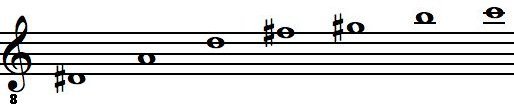
Later, I developed a generative Max version, which is still available for download. Initially, however, the installation was built entirely with CD players, as this made setup much easier. Had we used a computer, we would have needed a multichannel audio interface, several kilometres of cables and a much more complicated technical setup. It would have been impossible. So, I decided to build a very inexpensive yet reliable version using portable CD players.
The only limitation of the CD version was that the transpositions were fixed according to the harmonic scale that I had defined. In the Max patch, however, I implemented a more elaborate system in which the harmonic material itself can be stretched too. A stretch factor changes the harmonic relationships every few minutes. Sometimes the spectrum is stretched very widely and sometimes only very slightly.
Initially, however, the installation was built using only CD players, as this made the setup much easier. Had we used a computer, we would have needed a multichannel audio interface and several kilometres of cables, not to mention a much more complicated technical setup. It would have been impossible. So I decided to build a reliable but inexpensive version using portable CD players.
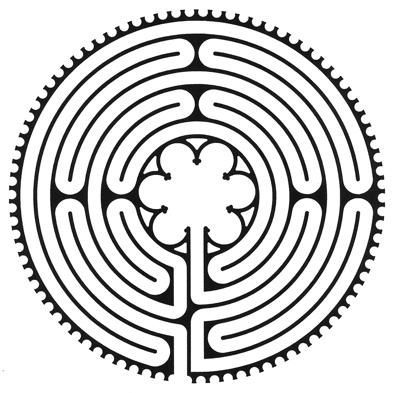
Labyrinth on the floor of Chartres Cathedral
In your text Computer-Aided Composition (1991), you describe how you envisioned a distribution of sound material across a two-dimensional plane, which the composition could then traverse by following a winding labyrinth such as that of Chartres Cathedral. You suggest that, in a way, your string quartet *Helix 1.0* stems from these reflections. Have you used this idea (sound material distributed in a two- or three-dimensional space and then “visited” by a path) in other fully generative compositions?
Yes. I spent many years thinking about how to solve this problem, and I only arrived at a satisfactory solution much later, in 2018. At that time, I was working on the idea of a generative soundscape generator, based on binaural recordings. I am using a special microphone system developed by Sennheiser, called Sennheiser Ambeo Smart Headset. The microphones are placed inside your ears, effectively turning your head into an artificial dummy head, so to speak. Connected to an iPhone, the system allows you to make high-quality binaural recordings.
What I find particularly interesting is that it simply looks as though you are listening to music, whereas in fact you are recording. As a result, you can record soundscapes in which no one would suspect that you are actually recording. This is especially valuable for sensitive field recordings, where you want to capture situations that people might otherwise be reluctant to have documented.
H.E.A.D. (Hearing Entirely Artificial Dreams) is a work in progress that I started in 2018, and by now I have created 88 different pieces using this approach. The underlying concept is always the same: You have four binaurally recorded soundscapes, each of which has been carefully recorded and fixed in advance, without any randomization.

User interface of S.I.L.L.
© 2018 ff. by Karlheinz Essl
I created a two-dimensional Brownian motion within a virtual space that moves across a square plane. The four soundscapes can also be mixed manually by moving the mouse. Imagine that each sound originates from one corner and radiates towards the centre. In S.I.L.L. (Sounds Intercept Little Lovers), for example, one sound is of a pasture with cows, another is of one of my sound installations in a public space, another was recorded in the Tyrolean mountains, and the last is of the cemetery in Mittersill, Tyrol, where Anton Webern is buried.
As you move the cursor, the soundscapes gradually crossfade into one another. Instead of controlling the movement yourself, however, you can also activate an automatic mode (the Brownian motion). The piece is best experienced with headphones, of course.
Initially, I wanted to create sonic "portraits" of cities with four-letter names, such as G.R.A.Z, W.I.E.N, or O.S.L.O. Eventually, however, I ran out of suitable cities… [laughs]
Now I think I would rather create pieces that are not based on cities but instead pay homage to particular figures, such as John Cage. One of these pieces is called C.A.G.E. and is based on recordings made during a John Vage festival in Vienna.
C.A.G.E. (Casino Atmosphere Generating Empathy) - binaural
© 2018 by Karlheinz Essl
It's a labyrinth without any walls where you can move freely. The Chartres labyrinth is interesting because, no matter where you start, it leads you through a complex structure to the centre. Once you arrive there, you will have passed through all the different parts of the pattern. Rather than following this fixed labyrinthine path, I use a more open approach. It is not teleological. The goal is not to reach the centre, but to simply move through the space.
And are there other pieces in your work exploring this idea of virtual space in generative way?
There is a recent piece called The Other Day, commissioned by the Musikprotokoll festival in Graz, based on my own poems, which have been translated into German, English, French and Italian. It is an interactive sound installation which uses a tracking system: audience members lie on a rolling board and wear headphones, enabling them to move through the space. From this position, they can explore a virtual environment consisting of soundscapes and voices. The voices whisper in an ASMR style.
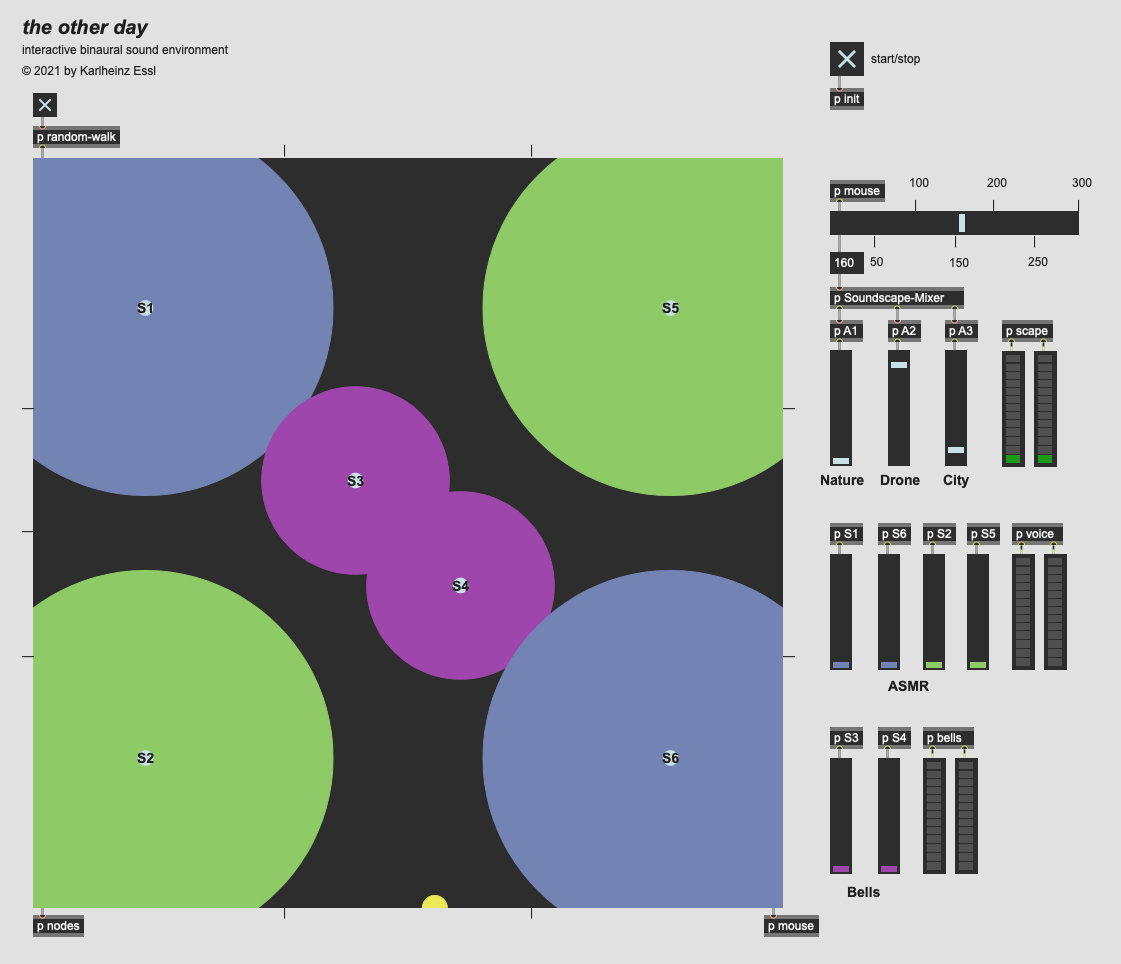
Simulation software for the other day, written in Max
© 2021 by Karlheinz Essl
As the audience moves, they gradually begin to recognise spatial patterns: for instance, that the French whispering comes from a specific direction, or that moving toward the center reveals more bells and other elements…
Regarding spatialization activated by the listener’s movement through an installation, could you tell me more about Klanglabyrinth?
Klanglabyrinth later changed its name. What I am describing is an early version of a generative piece that I developed in Max before Max/MSP existed. At that time, it was still MIDI-based, although I was already able to work with samples. Once MSP was released, making real-time sound generation possible, I reworked the piece in Max/MSP and gave it a new title: Amazing Maze.
The first version of Klanglabyrinth took place in a kind of virtual architecture built in the physical space by architect Carmen Wiederin. It is not easy to describe in simple terms: there were physical elements, including movable walls that the audience could rearrange, as well as barriers to climb over. Different positions in the space were equipped with loudspeakers, so the sound changed depending on where you were. At the same time, the room itself could also be altered through movement, by shifting these walls and objects.
Later, I presented the work at the Salzburg Festival. There, it was installed in the Mirabell Garden, which worked very well with the concept. At that time, in 1997, I was still using CD players with pre-recorded tracks in shuffle mode, distributed across eight loudspakers. Visitors could walk through the garden and experience the sounds as they moved around.
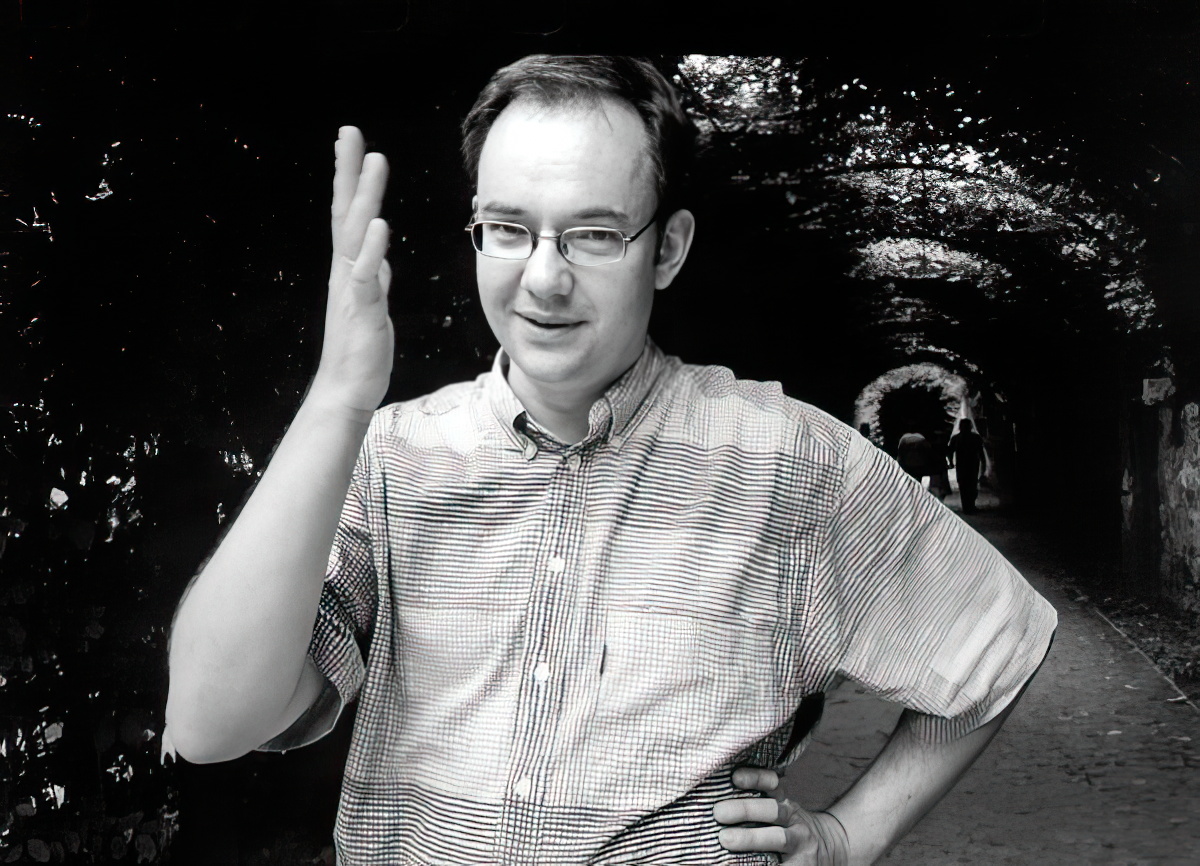
Karlheinz Essl in his sound installation Amazing Maze
Mirabellgarten, Salzburg
Photo: © 1997 by Marion Kalter
Has the biological metaphor served as an operational model in any of your generative works?
Yes, indeed! I talked about this concept in my lecture Klangkomposition und Systemtheorie during the Darmstadt Summer Courses 1993 which was published 1994 in "Darmstädter Beiträgen zur Neuen Musik".
Before studying musicology and composition, I attended a chemistry school. The alchemiical concept of transmutation inspired me a lot. During my composition studies, I came across the book of Ilya Prigogine and Isabelle Stengers Order Out of Chaos. Man's New Dialogue with Nature (Bantam Books: New York 1984) which had a strong impact on my compositional thinking. Decades later I wrote about this book and how it changed my artistic perspective in Meine zehnundeins Lieblingsbücher:
“Here, the authors describe how, in chaotic systems that are not in equilibrium and are not closed off from the outside world, counterforces come into play that—contrary to the postulates of classical thermodynamics—can establish new states of order. The consequences of this insight seem to reach further than one might suspect at first glance: there is a distinct whiff of revolution here, one that calls into question not only a physical worldview but any rigid, authoritarian worldview. What is fascinating about Prigogine’s research is the new, non-hierarchical concept of order. Chaos and order are no longer seen as contradictions, but as extreme poles between which a variety of transitions are possible. We encounter this phenomenon at every turn in our daily lives. On the one hand, chaos can arise from principles of order when their complexity is so great that the result takes on the character of “hidden predictability.” Conversely, however, areas of order can emerge within chaos when forces are mobilized within the system that counteract the threat of disintegration.”As a trained chemist, this book was a true revelation to me, as it turned all the principles of my scientific understanding upside down. But the message was liberating: even within chaos, there are tendencies toward self-organization, and supposed order can give way to the indeterminate. These insights coincided with my exploration of serialism at the time, which raised similar questions. Shortly thereafter, I bought my first computer (an ATARI ST) and began writing chaotic and aleatoric programs. But that was only the beginning…
These systems-theoretical reflections naturally changed my compositional thinking. I wrote my first 'real' Opus 1, my string quartet Helix 1.0 (1986), and later the essay Sound Composition and Systems Theory, which I presented at the 1990 Darmstadt Summer Courses."

Lecture Klangkomposition und Systemtheorie
Darmstädter Ferienkurse für Neue Musik, 16. Juli 1990
Home Works Sounds Bibliography Concerts Updated: 10 Jul 2026
