| 16step-seq | Abstraction | rhythmical sequencer |
| @ | Abstraction | Scales a standard slider (ranging from 0 to 127) between min and max |
| add% | Abstraction | Adds a certain percentage <int, float> to values <int, float> in left inlet |
| alea | Abstraction | random based object |
| alea-rhythm | Abstraction | rhythm generator |
| anti-bis | Abstraction | Filters out immediate repetitions of integers. Right output sends a bang whenever this occurs |
| anti-bis&osc | Abstraction | Filters out direct repetitions and when a number has occured the penultimate time |
| anti-interval | Abstraction | Filters out a certain interval |
| anti-octave | Abstraction | Filters out octaves between two consecutive notes |
| anti-octave&prime | Abstraction | Filters out octaves and primes |
| anti-osc | Abstraction | Filters out an integer which has occured the penultimate time |
| banger | External | An object to bang outlets sequentially |
| between | Abstraction | random based object |
| between-lin | Abstraction | random based object |
| between-lin-urn | Abstraction | random based object |
| between-log | Abstraction | random based object |
| between-log-urn | Abstraction | random based object |
| block-bang | Abstraction | Filters out bangs that arrive before a certain time span ("blocking time") is over |
| BPM2ms | Abstraction | Converts beats per minute (BPM) into milliseconds |
| brown-melody | Abstraction | Generates a brownian-mouvement-like melody |
| brown-rhythm | Abstraction | Generates a brownian-movement-like rhythm |
| brownian | Abstraction | random based object |
| butfirst | Abstraction | Outputs the input list without its first element |
| butlast | Abstraction | Outputs the input list without its last element |
| check-octaves | Abstraction | Checks whether an interval list sums up to an octave |
| check-row | Abstraction | dodecaphonic based object |
| choice-rhythm | Abstraction | rhythm generator |
| choose-intervals | Abstraction | Chooses a supply between one to five different intervals |
| collect | Abstraction | Collects numbers |
| contrario | Abstraction | A number <int, float> in left inlet outputs a complimentary number |
| cos-slider | Abstraction | Transforms a linear slider into a cosine function |
| count-bang | Abstraction | Counts the number of received bangs |
| countdown | Abstraction | countdown object |
| cp-pan~ | Abstraction | constant power panner |
| cresc-decresc | Abstraction | crescendo / decescendo generator |
| crossfade~ | Abstraction | Crossfades two input signals according to a sine function which guarantees that loudness of the result is constant |
| dB2lin | Abstraction | Converts dB into linear values |
| DblBang | Patch | Detects single or double bang |
| del-fb~ | Abstraction | Delay line with feedback |
| divmod | Abstraction | divmod is the same as / and % for positive left operands. |
| dur-from-ED | Abstraction | Calculates note durations from entry delays (ED) and a duration factor |
| ED-rhythm | Abstraction | rhythm generator |
| ED-trans | Abstraction | produces a ritardando or an accelerando |
| ED2EP | Abstraction | Converts ED (= entry delays) into EP (= entry points) |
| first | Abstraction | Outputs the first element of a list |
| first-bang | Abstraction | Outputs only the first bang of a stream of bangs |
| first-shot | Abstraction | Outputs only the first message of a stream of messages (bangs, ints, floats, symbols, lists) until the right inlet receives a (reset) bang |
| frq2note | Abstraction | Converts frequency into a note |
| geom | Abstraction | Int in right inlet outputs the nth member of a geometrical row. |
| grid-rhythm | Abstraction | rhythm generator |
| group | Abstraction | groups numbers received in succession into a list |
| group-rhythm | Abstraction | rhythm generator |
| group-rhythm2 | Abstraction | rhythm generator |
| groups | Abstraction | random based object |
| inc-dec | Abstraction | Functional implementation of the graphical user interface object Inc-Dec |
| infinity-row | Abstraction | pitch generator |
| insert | Abstraction | Inserts an element after a position (= index) in the list |
| integ | Abstraction | Accumulates input values <int, float> until a bang (or any input) is sent to the right inlet |
| intv2ratio | Abstraction | Converts an interval into a ratio |
| inv | Abstraction | Calculates the inversion of a number |
| join | Abstraction | Joins two lists together |
| key-bang | Abstraction | Sends out a bang whenever a certain key is pressed |
| Ladd | External | An object to add two lists, member by member |
| last | Abstraction | Outputs the last element of a list |
| Ldiv | External | An object to divide one list by another, member by member |
| lin2dB | Abstraction | Converts linear values into dB |
| listreg | Abstraction | this is for lists what the int object is for integers |
| listlen | Abstraction | listlen - outputs the length of a list or anything arriving at its inlet |
| Lmult | External | An object to multiply two lists, member by member |
| loop-sf~ | Abstraction | Loops a selected sndfile |
| Lpow | External | An object to raise the members of a list to the powers set in another list |
| Lrem | External | An object to divide one list by another, member by member and output a list of the remainders |
| Lround | External | Rounds off members of a list to desired precision |
| Lsub | External | An object to subtract two lists, member by member |
| make-choice-list | Abstraction | random based object |
| make-choice-list | Abstraction | random based object |
| make-ED-scale | Abstraction | list generator |
| make-scale | Abstraction | list generator |
| make-trans-scale | Abstraction | list generator |
| markov | Abstraction | probability based object |
| markov-harmony | Abstraction | pitch generator |
| markov-rhythm | Abstraction | rhythm generator |
| matrix12 | External | dodecaphonic row manipulations |
| max-cursor | Abstraction | 1 or 0 send to the inlet (or given as an argument) shows or hides the mouse cursor |
| max-menubar | Abstraction | 1 or 0 send to the inlet (or given as the argument) switches MAX's menubar on or off |
| max-overdrive | Abstraction | 1 or 0 send to the inlet |
| max-quit | Abstraction | Quits MAX immediately - BEWARE! |
| member | Abstraction | list based object |
| metro-dev% | Abstraction | rhythm generator |
| minus | Abstraction | Simply makes the negative of an int sent to the input |
| ms2sec | Abstraction | Converts milliseconds into seconds |
| MSP-iovs~ | Abstraction | select I/O vector size |
| MSP-sigvs~ | Abstraction | select signal vector size |
| MSP-sr~ | Abstraction | Sets the sampling rate of MSP |
| MSP-takeover~ | Abstraction | MSP takeover |
| multiple | Abstraction | list based object |
| neutral-harmony | Abstraction | pitch generator |
| normalize-row | Abstraction | Normalization of a twelve-tone row |
| note2cents | Abstraction | Shows how many cents a microtonal note <float> is deviating from a tempered one |
| note2frq | Abstraction | Converts a note into frequency |
| note2pitch | Abstraction | Outputs the pitch class of a note |
| note2st | Abstraction | Outputs the intervals of an incoming stream of notes |
| nth | Abstraction | outputs the nths element of a list |
| panning | Abstraction | Equal power panning based on John Chowning's paper "Simulation of Moving Sound Sources" |
| pass | Abstraction | Let a certain percentage of bangs pass |
| pass-bang | Abstraction | Let every nth bang pass |
| per2pass | Abstraction | Converts a periodicity factor <float between 0 and 1> into a percentage value <int between 0 and 100> for the pass-object |
| periodic | Abstraction | random based object |
| permutate | Abstraction | random based object |
| permutate-row | Abstraction | dodecaphonic based object |
| permute | External | returns the nth permutation of a list |
| piece | Abstraction | list based object |
| pitch-from-intervals | Abstraction | pitch generator |
| pitch-from-row | Abstraction | pitch generator |
| pitch-from-row | Abstraction | pitch generator |
| pitch-from-row-mod | Abstraction | pitch generator |
| pitch-from-row-mod | Abstraction | pitch generator |
| pitch2note | Abstraction | Combines pitch class and register into a note |
| play | Abstraction | Plays a note whenever a key number is sent to the left inlet |
| play-samp~ | Abstraction | Plays one sample |
| play2 | Abstraction | Plays a note whenever a key number is sent to the left inlet |
| position | External | position - sorts a list in the left inlet using the index numbers in the right inlet |
| QT-PercPlayer | Abstraction | Plays General MIDI percussion instruments directly from Quicktime |
| QT-SndPlayer | Abstraction | Plays General MIDI instruments directly from Quicktime |
| random-norep | Abstraction | random based object |
| random-pan~ | Abstraction | random pan |
| random-ramp | Abstraction | Generates randomly fluctuating envelope shapes of a given dynamic scale |
| random-row | Abstraction | random and dodecaphonic based object |
| RandomSeeder | Abstraction | random based object |
| ratio | Abstraction | Chooses elements from a supply <int list> which are repeated according to a multiple list <int list> by using the "series" selection principle |
| ratio2intv | Abstraction | Converts a ratio into an interval |
| reanimate | Abstraction | Sends out a bang on right outlet after x miliseconds if there has been no input bang in left inlet during x miliseconds |
| remove | Abstraction | Removes the nth element of a list |
| remove-dc~ | Abstraction | Removes the DC offset of an audio signal |
| repchord-rhythm | Abstraction | rhythm generator |
| repeat-ED | Abstraction | sends out a certain number of rhythm bangs |
| replace | Abstraction | Replaces an element of a list |
| reverse | Abstraction | reverses a list of numbers |
| rit-acc | Abstraction | Generates a ritardando or an accelerando |
| rota | Abstraction | random based object |
| rotate | Abstraction | cyclically rotate a list |
| round | Abstraction | round to next higher integer |
| roundto | Abstraction | A number sent to right inlet is rounded onto a certain "grid" <int, float> sent to right inlet |
| row-modus | Abstraction | dodecaphonic based object |
| rtc.fullscreen | Abstraction | toggles between full screen and window view |
| samp10~ | Abstraction | Allows a polyphony of up to 10 samples at the same time |
| scale-changer | Abstraction | scale changer |
| schweller | Abstraction | decrescendo-crescendo envelopes generator |
| scramble | Abstraction | scrambles the order of a list of numbers |
| sect | Abstraction | outputs a list which contains only atoms that appear in both input lists |
| sel-princ | Abstraction | random based object |
| sequence | Abstraction | outputs the next element of a list |
| serial-rhythm | Abstraction | rhythm generator |
| series | Abstraction | random based object |
| show | Abstraction | Displays a list in a message box |
| showchord | Abstraction | Shows the pitch of a chord of MIDI note numbers |
| shownote | Abstraction | Shows the pitch of a MIDI note number |
| slice | Abstraction | divides a list in two |
| smooth-line | Abstraction | Interpolates smoothly between successive input values |
| sneak | Abstraction | random based object |
| sneak-random | Abstraction | random based object |
| sneak-rhythm | Abstraction | rhythm generator |
| sort | Abstraction | sorts a list |
| sqrt-pan~ | Abstraction | square root panner |
| st2pitch | Abstraction | Accumulates incoming intervals and outputs pitch classes |
| sum | Abstraction | Sums up a numerical list containing integers and/or floats |
| super-rhythm | Abstraction | rhythm generator |
| trans | Abstraction | transition |
| trans-exp | External | exponential transition |
| trans-lin | Abstraction | linear transition |
| trans-log | Abstraction | logarithmical transition |
| transp-pitch | Abstraction | Transposes pitch classes by a certain interval |
| transpose-row | Abstraction | dodecaphonic based object |
| union | Abstraction | outputs a list which contains all atoms that appear in either or both input lists |
| unique | Abstraction | unique puts out a list comprised of those items in the left input list that are not contained in the right input list |
| VolAmb | Abstraction | Controls the ambitus between minimum and maximum dynamic by a single controller |
| xrandom | Abstraction | random based object |
In order to create an evironment which enables one to concentrate rather on high-level compositional questions than on low-level technical problems, Gerhard Eckel and I started to develop a set of tools which became the corner stones of the RTC-lib. At the this time, Serge Lemouton (my musical assistant at IRCAM) wrote "nth" according to my indications, James McCartney released his "list objects", and a few years later Peter Elsea developed his "LObjects" (inspired by RTC-lib, as he told me). Some externals from these packages were included into the RTC-lib, and Peter Elsea was nice enough to port some of my abstractions (like trans-log) to C-externals.
On this basis, I developed a large number of higher-level compositional algorithms written as "abstractions" (objects, coded in Max): rhythm generators, harmony generators, chance operations, ramp generators, MSP functions etc. which are often based on those primordial externals that have been implemented by other authors.
Those externals (the low-level side of the RTC-lib) need to be re-compiled for each operation system. We had to make the shift from 68k processors to PPC, and now to OSX. Thanks to Peter Elsea and Thomas Grill most of the externals has been ported to Windows XP and I transformed some Macintosh specific externals back to abstractions. Thanks also to Frank Barknecht who made a version for Pd.
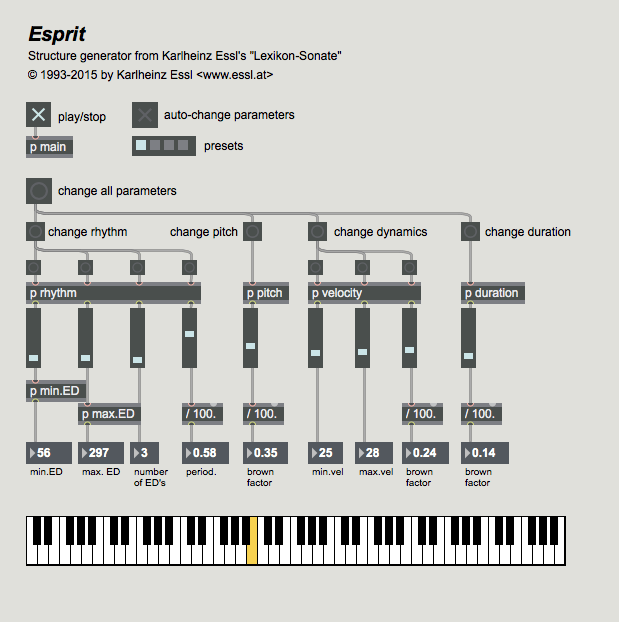
This tutorial shows how selected compositorial issues such as harmony, rhythm, and random can be mastered with the aid of the RTC-lib. Furthermore it contains several especially adapted and documented structure generators from Karlheinz Essl's Lexikon-Sonate such as Trill, MeloChord, and Esprit.