
Lexikon-Sonate
algorithmic music generatorinfinite realtime composition for computer-controlled piano
© 1992-2020 by Karlheinz Essl
vs. 6.0 (64-bit) NEW
for macOS and Windows


released: 20 May 2020 (Freeware)

released: 20 May 2020 (Freeware)
|
"The compositions generated by Lexikon-Sonate are surprisingly pleasant and interesting, mainly because of the ingenious manner in which tempo and volume vary and in particular due to a liberal use of pauses and silence. Many composition automatons suffer not from a lack of variety but from an inability to take a breather. Hats off to Herr Essl for this wonderful gift." (kornball)

|
 Lexikon-Sonate is an interactive realtime composition environment for musical composition and live performances. It takes advantage of composition algorithms that has been developed by Karlheinz Essl since 1985. With this algorithmic music generator on can create fascinating and complex musical structures on the fly. Furthermore, Lexikon-Sonate is an infinite music installation that can run on a computer for years without repeating itself. Finally, Lexikon-Sonate can be used as an instrument for live performance of algorithmic piano music.
 Lexikon-Sonate est un environnement interactif de composition en temps réel permettant de créer rapidement des structures musicales complexes. Il peut être utilisé comme installation sonore ou comme instrument pour performance live.
 Lexikon-Sonate es un entorno de composición interactivo en tiempo real para composición musical y actuaciones en vivo. Aprovecha los algoritmos de composición que ha desarrollado Karlheinz Essl desde 1985. Con este generador de música algorítmico, puede crear estructuras musicales complejas y fascinantes sobre la marcha. Además, Lexikon-Sonate es una instalación de música infinita que puede ejecutarse en una computadora durante años sin repetirse. Finalmente, Lexikon-Sonate se puede utilizar como instrumento para la interpretación en vivo de música algorítmica de piano.
Instead, the instructions for playing the piano - the indication "which key should be pressed how quickly and held down for how long" - are directly generated by a computer program and transmitted immediately to a player piano (or a software sampler) which executes them.

Navigation map of the electronic Lexikon-Roman
© 1992-98 by Libraries of the Mind
The title Lexikon-Sonate refers to the "Lexikon-Roman", written in 1968-70 by the Austrian-Slovakian author Andreas Okopenko. This novel appears to be one of the very first literary HyperTexts, independently of Ted Nelson who introduced this term about the same time. This novel - "a sentimental journey to a meeting of exporters in Druden" (subtitle) - consists of several hundred small chapters which were brought into alphabetical order. By reference arrows as in a lexicon the reader could make her own investigations through the multiple nested web structure of the text. Instead of presenting a sequential text with a predefined direction of reading, Okopenko provides a structure of possibilities, which challenges the reader to become a creator of her own version of this novel.
Excerpt of Karlheinz Essl's lecture The Chances of Chance
University of Nottingham, 2 Feb 2016
Originally, Lexikon-Sonate was conceived as a musical commentary to an electronic implementation of Okopenko's "Lexikon-Roman", carried out by the interdisciplinary group "Libraries of the Mind". But soon afterwards it started its own life due to its manifold ramifications, becoming an outstanding example in the domain of algorithmic composition.
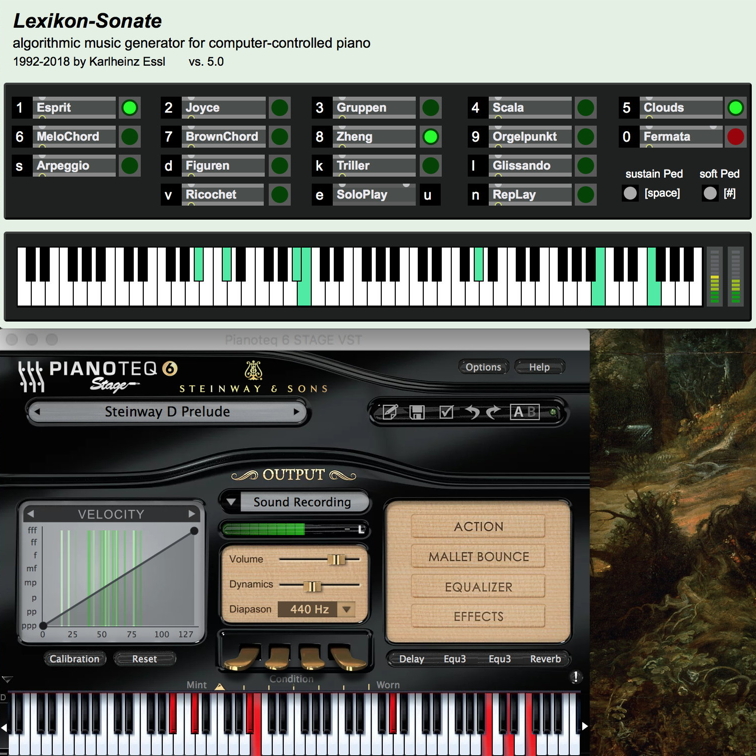
User interface of Lexikon-Sonate 5.0
Lexikon-Sonate consists of a variety of music-generation modules (so-called structure generators) which are related in a very complex way as a musical HyperText. Each module generates a specific characteristic musical output as a result of the compositional strategy that has been applied. A module represents an abstract model of a specific musical behaviour. It does not contain any pre-organized musical material, but a formal description of it and the methods how it is being processed.
These modules are structural re-implementations of piano gestures obtained by analysis of piano music from Johann Sebastian Bach, Mozart, Beethoven, Schönberg, Webern, Boulez, Stockhausen and Cecil Taylor. They will never appear as verbal quotation (because none of this gestures has been "sampled"), but mainly as "allusion". Furthermore, they are open and generic enough so that different modules playing at the same time can intermingle, creating unpredictable meta-structures.
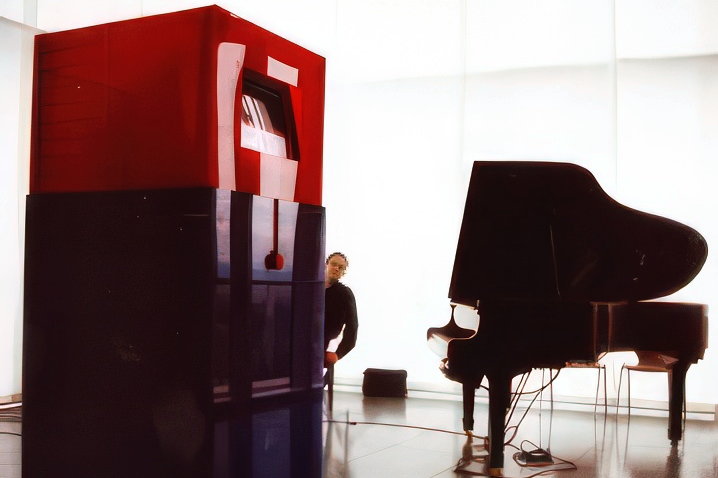
Installation at KLANGTURM ST. POELTEN (summer 1998): Lexikon-Projekt
Computer-Stele (design: Regina Freimüller) - Yamaha Disklavier
The idea of autopoiesis - material organizing itself due to certain constraints - plays an important rule. By using a lot of different random generators which are controlling each other (which - according to serial thinking - form a scale between a completely deterministic and a completely chaotic behaviour), always new variants of the same model are generated. Variants that may differ dramatically from each other, though they are always perceptable as "inheritances" of the given structural model. Seen in this light, Lexikon-Sonate can be perceived rather as a meta-composition which enables the unfolding of piano music than a fixed work.

Karlheinz Essl performing Lexikon-Sonate on a Bösendorfer CEUS computer piano
Bösendorfersaal, Vienna (12 Dec 2008)
© 2008 by Wladimir Fried
The underlying program was written in MaxMSP (© 1990-2015 IRCAM / Cycling '74), an interactive graphical programming environment for multimedia, music, and MIDI. Having worked with computers for many years - designing my own xLOGO-based software environment for Computer Aided Composition - I felt the challenge to write an interactive computer program which is able to compose in real time. For this purpose I took advantage of my Real Time Composition Library (RTC-lib), a collection of MAX-objects designed for musical composition which includes a variety of musical functions, compositional techniques, and algorithmic strategies.
Lexikon-Sonate (1992 ff.) performed by the composer on a Yamaha Disklavier
NIME Conference 2016, Brisbane (Australia)
Jul 12th, 2016
Lexikon-Sonate (1992 ff.) performed on a Bösendorfer SE Grand Piano - world premier
Großer Sendesaal des Österreichischen Rundfunks, Vienna (Austria)
Feb 10th, 1994
Lexikon-Sonate (1992 ff.) performed by the composer on a Yamaha Disklavier
12 Jul 2016, NIME Conference 2016 (Brisbane, Australia)
Karlheinz Essl performing Lexikon-Sonate on a Steinway, equipped with a transducer
29 Nov 2014, The Hague (Royal Conservatory of Music)
Karlheinz Essl performing Lexikon-Sonate on his laptop
23 Sep 2011, Montreal (Concordia University)
Karlheinz Essl performing Lexikon-Sonate on a Bösendorfer CEUS computer piano
12 Dec 2008, Vienna (Bösendorfer-Saal)
German 
Dutch / Flemish
Italian
Dansk 
Russian 
The work provided here for download is licensed under the Creative Commons Attribution-NonCommercial-NoDerivs 3.0 License. You are free to copy, distribute, display, and perform the work under the following conditions:
Your fair use and other rights are in no way affected by the above.
As some people have misused the MIDI feature for generating musical structures to be used for their own compositions, I decided to prevent this by disabling the MIDI facility. One should also be aware that the Creative Commons Licence under which Lexikon-Sonate is released does not allow derivative works.
With the new version 5.0 (released on June 1st, 2018), you can load your favorite VST Piano PlugIn (such as Pianoteq or Addictive Keys) as a playback device for HiFi piano sound.
However, there exists a MIDI-fied version which I exclusively use for my own performances of Lexikon-Sonate. For public installations of Lexikon-Sonate with a Yamaha Disklavier, I am willing to supply a MIDI-fied version on the basis of negotiation. In this case, email me.
|
Lexikon-Sonate 6.0 (64-bit) for macOS 10.14 - macOS 12.2
NEW released 20 May 2020: ZIP archive (17.3 MB) |
|
Lexikon-Sonate 5.0 for macOS 10.10 or later released 1 Jun 2018: ZIP archive (26.9 MB) |
|
Lexikon-Sonate 5.0 for Windows released 19 Jun 2018: ZIP archive (11.9 MB) |
 |
Lexikon-Sonate 4.0.1 for Mac OS X (10.4. or later) - for Intel and PPC processors
released 5 Dec 2010: ZIP archive (10.6 MB) |
|
Lexikon-Sonate 3.3 for Mac OS X (10.4.11 - 10.6) - for Intel and PPC processors using Quicktime Sounds as output device released 22 Dec 2009: ZIP archive (6.4 MB) |
 |
REplay PLAYer (© 2000-2024) generative sound file shredder REplay PLAYer is a computer program that de-constructs a given sound file and re-composes it by using realtime composition algorithms. It can be used as a tool to generate an infinite and every-changing sonic stream from a single sound file for artistic, compositional or mere recreational purposes. It can also be regarded as a computer based instrument for live performances, as an interactive sound installation or a generator for ambient music. |
 |
fLOW (© 1998-2023) ambient soundscape generator fLOW is an audio computer program running on Apple Macintosh machines. It generates an ever-changing and never repeating soundscape in real time that fills the space with flooding sounds that resemble - metaphorically - the timbres of water, fire, earth, and air. This ambient sound scape generator adjusts itself through various parameters and controllers that are represented in real time on your screen. |
| Home | Works | Software | Sounds | Bibliography | Concerts |
Updated: 7 Jul 2026
